UN World Population Prospects 2024 · 237 countries · 1950–2100
Human life starts as a child.
IFFS Lens™ is an in-depth scientific analysis of publicly available estimated data courtesy of the UN Population Division — World Population Prospects (WPP) 20241. The IFFS Lens™ brings life to numbers, makes them have a meaning to you, to demographers, to politicians, to health system decision makers, to practitioners and women and men of this planet. Be brave, take time to understand the data, the message and explore what you can do towards dissemination.
Scroll to follow the story
Cool below 2.1 births per woman, warm above. The scale pivots on the replacement threshold, not on the midpoint of the data.
If a country wishes to maintain a steady population, the number of children per woman should be 2.1, representing the Total Fertility Rate (TFR).

If a country wishes to maintain a steady population, the number of children per woman should be 2.1, representing the Total Fertility Rate (TFR).
In 1950, no country had a TFR below 2.1.
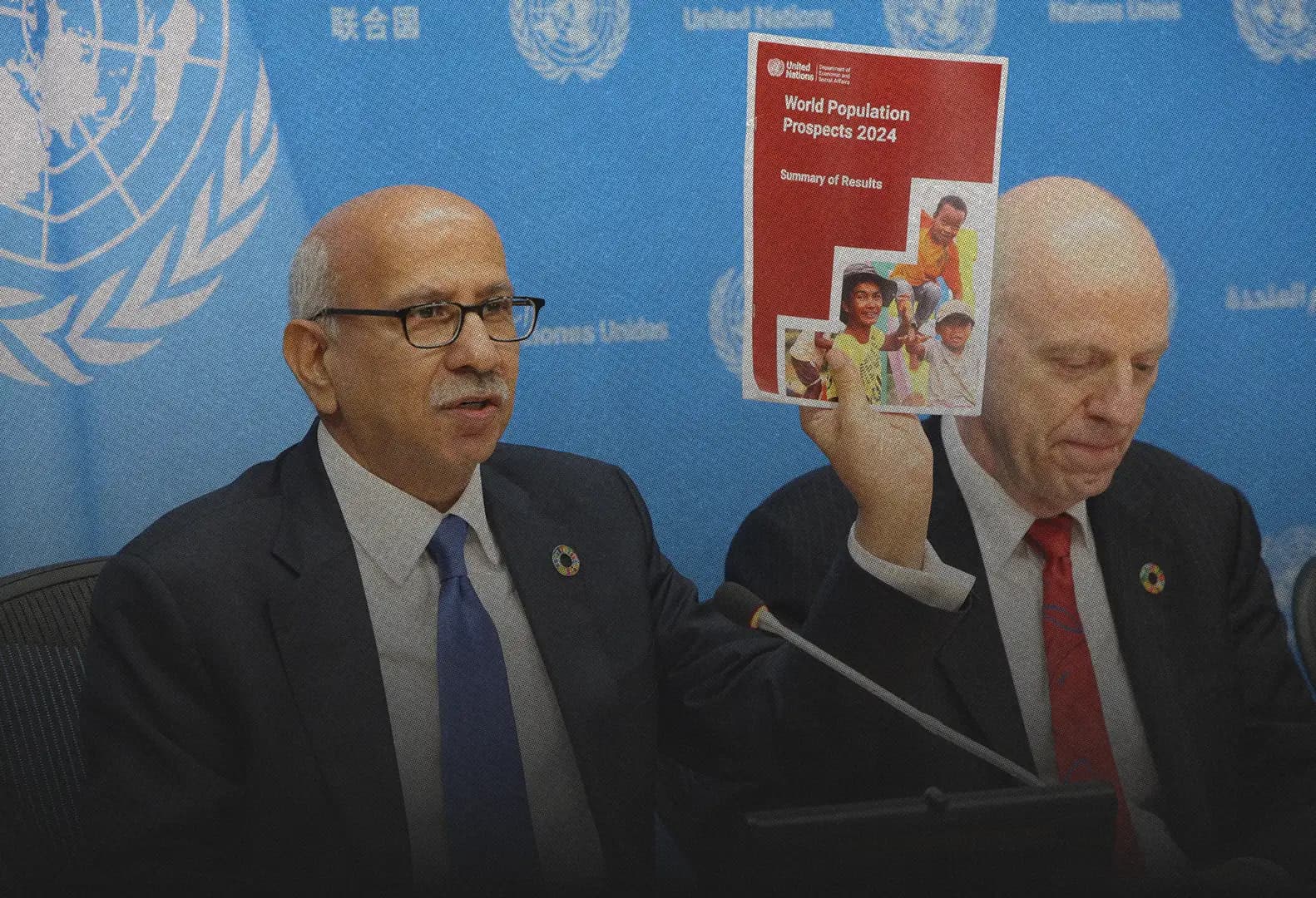
These children are on the cover of United Nations World Population Prospects 2024.
55% (130/237) of countries have a TFR below 2.1 in 2023. The number of children born worldwide is decreasing. Only Africa continues to grow.
On 11 July 2024, World Population Day, the UN Population Division published World Population Prospects 2024.
The 28th edition of the UN’s population estimates and projections. In its medium scenario the world peaks at 10.3 billion people in 2084, then eases to 10.2 billion by 2100.
The figures that you see here are from the analysis of the UN World Population Prospects 2024 report.
60 indicators for 237 countries and areas, from 1950 to 2100. Scroll on to see what they show.
The number of children born worldwide annually is decreasing.In 1950, 91.8 million children were born.Births rose to a peak of 146.1 million in 2012 and have fallen every year since 2016.132.1 million children were born in 2023, almost 14 million fewer than at the peak.
IFFS Lens™
What this atlas analyses?
Sixty indicators, thirteen scenarios, 237 countries and areas, every year from 1950 to 2100. All publicly available estimated data courtesy of the UN Population Division — World Population Prospects (WPP) 2024.
Infant Mortality Rate – 2023 Estimate
The IFFS Lens™ graphically interprets and places into context the numbers presented by the UN body with the intention to explain to the expert and non-expert readers the state of the world we live in compared to more than 70 years ago and also estimates for the next 77 years. The indicators interpreted span migration, fertility, infant health, mortality and life expectancy to name just a few.
Female population in thousands (Age Group 30 to 44) – 2023 Estimate
The Total Fertility Rate (TFR) is a retrospectively measured parameter, this is why the IFFS Lens™ atlas presents an age-and-sex analysis, focusing on women aged 30‑44y old.
Female age at childbearing
The Impact
Women's mean age at childbearing was 28.9 years in 1950, fell to 27.0 by 1995 as large families gave way to small ones, and has risen since, to 28.2 in 2023. It is projected to reach 30.2 by 2100. Among countries of more than a million people, the broadest shift since 1950 was in the United Arab Emirates, 4.2 years (27.7 to 31.9), and the narrowest in Cuba, 0.0 years (26.2 in both 1950 and 2023). Delaying births raises the risk of pregnancy complications for mother and baby, particularly after age 35, and, because fertility declines with age and IVF cannot fully compensate, is linked to smaller families on average.
The IFFS Lens™ atlas presents cohort fertility data
Cohort fertility is the Total Fertility Rate (TFR) for women born in a given year: the actual number of children, on average, for all women born in a single year. Korean women born in 1935 completed 4.51 children. Those born in 1968 completed 1.88. The period rate today reads 0.72, yet this does not reflect the total number of children women will have over their lifetimes.
Source: Completed cohort fertility, World Population Prospects 2024
What matters most when discussing demographics is the ability to correctly analyse data, identify trends and act.
The IFFS Lens™ offers exactly this opportunity. Read and see the poorly understood reality of vast populational change to date and, even more alarming, the fast pace of change to come.
How do I access the analysis?
IFFS Lens™ comes with IFFS membership. Every IFFS member can sign in with their IFFS Hub login to save maps, compare countries and keep a watchlist. Members with IFFS Hub All Access Membership have Premium, which will later add in-depth analysis for researchers, industry and policy makers.
Become an IFFS Member (opens in a new tab)The atlas
Every country, every year, one surface
Turn the globe, scrub the century, compare the scenarios. The numbers behind every figure on this page are three clicks away, with their source and licence attached.
Lead contributors: IFFS Executive Committee, IFFS Appointees and Advisors, IFFS Board of Directors, IFFS Past Presidents, IFFS Next Generation Team and IFFS Special Interest Jurist Group. https://www.iffsreproduction.orgData Support: Portnov AgencyManagement and Operations: IFFS Secretariat - ICS EventsSources and Data: United Nations Department of Economic and Social Affairs, Population Division — World Population Prospects 2024. Country groupings rebuilt from UNSD M49, the World Bank income classification and UN-OHRLLS. Basemap © Mapbox © OpenStreetMap. Boundaries from Natural Earth. Fertility policy and practice: IFFS Biennial Report, published in Global Reproductive Health.Visualisations, Designed and Developed by: Heel Turn
World Population Prospects 2024 is published under CC BY 3.0 IGO. Boundaries and names shown do not imply official endorsement or acceptance by the United Nations. The thirteen projection variants are scenarios, not confidence intervals.
© 2026 International Federation of Fertility Societies. All rights reserved.